The Design of Virtual Environments (DOVE)

KICKOFF
An open-source web-based resource called Design of Virtual Environments (DOVE) is to be modeled after the editable architecture of Wikipedia but focused on research-based guidelines.
TheDOVE site is to be populated with contents based on a literature review of VE research and the results of the proposed studies, including available code and 3D assets. The tool's software development process will follow an agile, user-centered design process (Baxter, Courage, & Caine, 2015; Martin, 2003) in which we develop iterative DOVE prototypes that are refined based on feedback.
The development of the system will draw on PI Gilbert's research group's collective experience with interface design and usability evaluation. The DOVE website will be open to research-based contributions from other qualified contributors and will grow as this research field intensifies, representing a high-impact, lasting result of the initial investment proposed for this project. A recent NSF-sponsored workshop on VR (see Results of Prior NSF Support) suggested that:
HIGH-LEVEL TIMELINE
I was the lead researcher and designer. Prior work and content created by Kim Knuth, Moriah Zimmerman, and Mindy Hoover
MAKE OF THE TEAM
Feb-April 2021 A 3-week sprint, 2 weeks for research, synthesis, and the other for ideation and execution.
KEY GOAL
Identify how each user finds content, digest, and contribute content
TOOLS
Figma, Whimsical, Peer-reviewed research articles, Gantt chart in Notion and WordPress
The Challenge of Knowledge Translation from Research to practice
The transfer of knowledge from theory to practice is a tedious process that requires iteration and moderation because it requires collaboration from experts and the stakeholders and will be required to adapt as context and tools change. A three-sided relationship between researchers, educators and practitioners is the most valuable partnership for knowledge translation. This relationship creates interaction and teamwork between stakeholders. (Bjork IT et al.,2013)
There are several barriers to this translation: First, academic research often uses highly specialized language and formatting that may be unfamiliar to industry readers, even in the same area of work. For example, only 7% of CHI 2011 papers were formatted to support design practice (Colossus et al., 2019). Second, the storyline or process of academic work often unfolds over multiple years, at a much slower pace than industry evolves, so it can be difficult for industry practitioners to closely follow the academic story. Third, related to this dynamic, academic research results often provide very small, specific contributions to knowledge which may not be immediately applicable to the practitioner’s problem being solved today, and without a large frame of reference over multiple years, it can be difficult for the practitioner to assemble the relevant contributions to knowledge into something usable.

ASSUMPTIONS & PRIOR WORK

Following Norman Nielsen's process of the (UCD) User-centered design, undergraduate researchers working at VRAC institute at Iowa State had implemented a framework and foundation for the (DOVE) Design of virtual environment website site using a variety of research and design techniques such as; wireframing, heuristic analysis, and user journey mapping. These activities created a website using WordPress (CMS) content management software. The DOVE website aims to cover the main VR topics required in any VR application, including locomotion, object interaction, presence, and VR menu design. Although the undergraduate researchers had laid the foundations for the knowledge translation for the DOVE website, it was still missing actual content contributed by researchers.
DESIGN THINKING PROCESS
Empathize
Collect user feedback from user interviews and peer-reviewed research.
Understand
Use Affinity maps and priority matrix to derive insights, conduct competitive analysis
Test
Run usability tests and research to validate insights on the specific feature
Although the undergraduate researchers had laid the foundations for the knowledge translation for the DOVE website, it was still missing actual content contributed by researchers.
Based on UX principles and a personal expert review, there were immediate sightings of
improvements to the site to make it easier for designers and other stakeholders to use the findings
because it was not clear how researchers would submit their work to this site.
AREAS FOR IMPROVEMENT

Project plan in notion
MY ROLE
I was the sole Researcher and Designer picking up previous work from the previous researchers. I started out by mapping out my project plan in a Gantt chart and then crafted the interview questions, recruited and interviewed participants, and synthesized data. I collaborated with two designers to flesh out some ideas.
I chose in-depth qualitative interviews and usability feedback to learn how different stakeholders conduct research and use the site. I discovered three groups of users and broke them up further into separate groups.
The in-depth insight from expert researchers was valuable to learn the motivations of submitting research to an open-source platform.
UNDERSTANDING THE USER
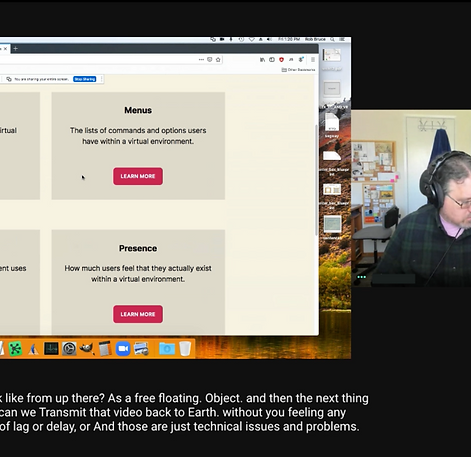
Evaluative User Interviews
I conducted a competitive analysis of research websites and platforms.
Interviews
-
15 Semi-Structured Interviews
-
Academic Researchers, Designers, Product Managers, and Founders in the XR/VR
-
Men and Women in the VR space
Media review
-
Oculus developer guide
-
The ACM
-
Elsevier
-
Wikipedia
To synthesize the research, I used Affinity Mapping, Value Prioritization Matrix, Personas, and User Flows to translate findings from the interviews into Task flows and Jobs to be done.
COMPETITIVE & COMPARATIVE ANALYSIS
Oculus Developer Guide
Univeristy of Iowa Art and Life
Circuit stream


USER FEEDBACK& SYNTHESIS
Step 1
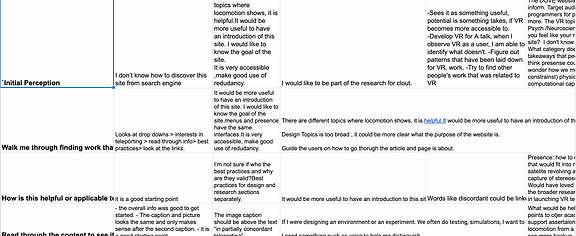
Step 2

Step 3

User Flows

