Improving controls and content curation on Youtube Kids

KICKOFF

ASSUMPTIONS
It is no surprise that (mobile phones, smartphones, tablets, and social media) dominate the lives of many children and adolescents. Parents feel torn in between helicopter parenting and allowing their children to watch content that they enjoy.
The stakeholder, a worried parent, whose children still watch Youtube came to us to seek solutions to the dilemma of choosing Youtube over Youtube kids because they and their children's needs weren't met on the Youtube kids app.
I don’t have kids and Youtube Kids was a new product to discover, hence the first step was to meet with my client to understand what the problem space was and we uncovered our assumptions based on personal knowledge and observation.
-
There is a problem of the pandemic, lack of schools and daycares and lots of small children are staying at home.
-
Children, unfortunately, have to use computers and mobile screen which creates a healthy obsession with screens
-
Parents are so busy that they often feel resigned towards giving them iPads and phones.
-
Parents feel like they would never let their children watch youtube.

Youtube but for children
YouTube Kids is an American children's video app developed by YouTube, a subsidiary of Google.
The app provides a version of the service-oriented towards children, with curated selections of content, parental control features, and filtering of videos deemed inappropriate viewing for children aged under 13, 8, or 5 depending on the age grouping chosen.
Categories on Youtube kids
-
Black Joy
-
Shows
-
Music
-
Learning
-
Explore
HIGH-LEVEL TIMELINE
February 2021
A 2-week sprint, 1 week for research, synthesis and the other for ideation and execution.
MAKE OF THE TEAM
I was the lead researcher and Ivan and Angelica supported through wireframes and high fidelity mockups
KEY GOAL
Uncover areas where Youtube kids can improve for children and for their parents.
TOOLS
Figma, Whimsical, Peer reviewed research, Gantt chart and Notion

IF YOUTUBE CONTENT IS JUST FOR KIDS THEN WHAT IS THE PROBLEM?
Although Youtube kids give parents the ability to monitor access a group of “trusted channels” as opposed to the entire swath of videos available on the YouTube Kids app. It is not a one-size-fits-all, many children find it boring and restrictive, parents are still not satisfied with the options and as a result, usage is low.
Parents will be able to turn off the search feature in the app, which will then only provide access to content recommended by the trusted video channels.

I was the Research Lead in a team of 3, I crafted interview questions, interviewed participants, and synthesized data.
I collaborated with two designers to flesh out some ideas.
Our Research Methods
Competitive analysis of other video apps for children.
-
Youtube
-
Amazon kids
-
Hulu
-
Disney+
-
Netflix Kids
Interviews
-
7 Semi-Structured Interviews
-
Men and Women 30s+
Surveys
-
18 survey respondents
Literature review
COPPA content for kids policy review
After which I used Affinity Mapping, Value Prioritization Matrix, Personas, and User Flows to translate findings from the interviews in to task flows.
RESEARCH INSIGHTS

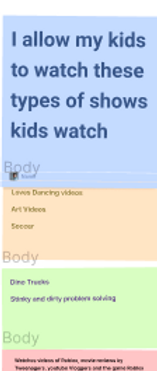
"I" statements


SELF-REPORTED OUTCOMES
1. Parents use the content on the videos to fill in unplanned time such as waiting for 10 minutes
Small children aged 4 and under, love predictability and are upset when there is an unknown gap.
2. Parents of older children want to trust their children instead of dictating what needs to be done.
3. Due to the pandemic children are lacking social integration. All or most of the socialization they are getting are from their parents, online videos and Tv shows.
4. There is way too much mind-numbing content that is sterile and age-appropriate but doesn't have social value. Some of these examples unboxing videos, gaming commentary, prank and movie reviews
Quantitative Survey Trends

68.4% of parents surveyed believe. 10-30 minutes of video is appropriate for their child
INSIGHTFUL PERSONAS
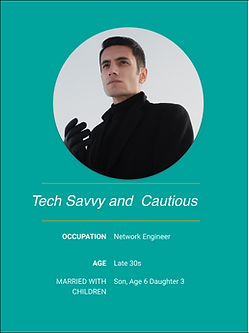
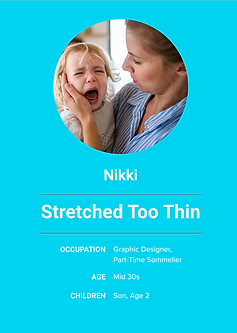
Based on the quantitative and qualitative findings from research with our parent participants, we created two personas named Nikki and Kumar to represent the high-level findings we created two personas because we found enough differences in the behaviors of participants that eventually led to overlapping solutions.
MY ROLE
I was the Research Lead in a team of 3, I crafted the interview questions, recruited and interviewed participants, and synthesized data. I collaborated with two designers to flesh out some ideas.
I chose quantitative surveys to quickly get feedback about the types of devices uses by parents, their awareness of Youtube kids, and general attitudes. We used qualitative interviews because we needed to gain in-depth insight into the motivations and pain points of parents to dispel wrong assumptions and validate our understanding of the problem.
Empathize
UNDERSTANDING THE USER


Evaluative and Generative Research
Competitive analysis of other video apps for children.
-
Youtube
-
Amazon kids
-
Hulu
-
Disney+
-
Netflix Kids
Interviews
-
7 Semi-Structured Interviews
-
Men and Women 30s+
Surveys
-
18 survey respondents
Literature review
Google's COPPA content for kids policy review
To synthesize the research, I used Affinity Mapping, Value Prioritization Matrix, Personas, and User Flows to translate findings from the interviews into Task flows and Jobs to be done.
During my interviews, my design colleague shadowed me and took notes to ensure that they were involved from the get-go. I scaled the data collected from survey participants over a 2 week period, I started by compiling the interview synthesis on post-it notes to find trends using "I statements".
I crafted research questions based on assumptions made by testing the app, and the body of research by (Burroughs,2017) represented by busy parents of small children aged 3-12 years old.
The combination of a kickoff interview with the stakeholder and one participant helped to inform the interview and survey questions which were broken down into Why What and How questions?
AFFINITY MAPPING
Empathize
Collect user feedback from survey data,peer-reviewed research.
Understand
Use Affinity maps and priority matrix to derive insights, conduct competitive analysis
Test
Run usability tests and research to validate insights on the specific feature

